Dancing Skeletons Embroidery Design
A Playful, Well-Placed Halloween Vibe—Not Just Another Spooky Clipart
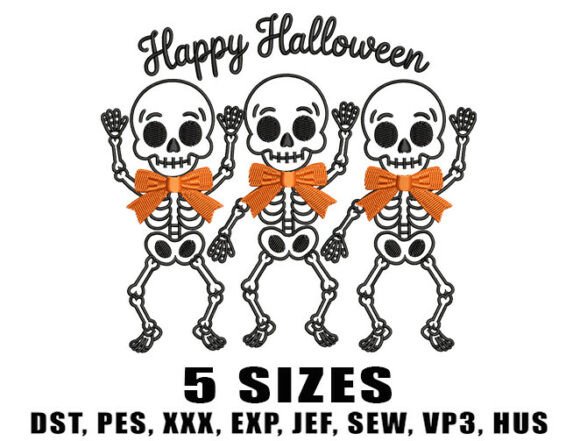
First impression? This isn’t a grim reaper or a haunted house—it’s three skeletons mid-groove, arms up, ribs bouncing, each with that bright orange bow tied just so. The mood is unmistakably lighthearted, even cheeky. It reads as handmade charm rather than mass-produced Halloween decor. As someone who’s stitched hundreds of seasonal designs for clients and my own craft business, I immediately pictured it on a natural canvas tote bag—something sturdy, unbleached, with room to let the design breathe. Not too dense, not too fussy—just confident, rhythmic, and full of personality.
Where It Shines: Real Projects, Real Customers
I tested Dancing Skeletons Embroidery Design across several real-use scenarios—and it held up best where playfulness meets practicality. On a medium-weight cotton sweatshirt? Crisp and joyful. The orange bows pop against charcoal grey fabric without needing metallic thread or extra embellishment. On a baby onesie (using soft, low-density fill stitch), the scale stayed friendly—not overwhelming, not lost. For an embroidered patch meant to be ironed onto denim jackets or backpacks, the clean outer edges and balanced negative space made it easy to trim and finish cleanly.
Etsy sellers will appreciate how well this translates into a printable mockup: it photographs clearly in natural light, reads at thumbnail size, and fits seamlessly into a “spooky-but-sweet” holiday collection alongside ghosts with cupcakes or jack-o’-lanterns holding tiny pumpkins. As a small shop product, it adds instant thematic cohesion—especially when paired with coordinating tea towels or pillow covers that feature simpler motifs like candy corn or bats.
Where to Pause—And Why
This isn’t a one-size-fits-all embroidery file. Its charm depends on thoughtful placement and context. Avoid cramming Dancing Skeletons Embroidery Design into a tiny 3-inch hoop on a curved cap front—the limbs and bows lose definition, and the satin-stitched outlines can blur on stretchy twill. Similarly, on thin or loosely woven fabrics like lightweight linen napkins, you’ll need a tear-away + cut-away stabilizer combo to prevent puckering around those fine bone contours.
Dark fabric backgrounds are flattering—but only if your orange thread is truly vibrant. Some budget-friendly orange threads dull under stitching pressure; test first. And while the design avoids ultra-fine details (no tiny eyes or teeth to vanish mid-stitch), the bow loops do rely on consistent tension. If your machine struggles with satin stitch transitions, consider slowing the speed or adjusting top tension before running a full batch.
What It Does for Your Brand—and Your Buyers
When customers see Dancing Skeletons Embroidery Design on a finished product, they don’t just register “Halloween.” They register *intention*. That bow isn’t an afterthought—it’s a deliberate wink. That rhythm in the pose suggests movement, energy, care. For handmade product buyers, that nuance builds trust: this wasn’t slapped on; it was chosen, tested, and thought through.
In a boutique setting or craft fair booth, this design helps differentiate you from generic pumpkin prints. It supports brand consistency if your shop leans into whimsical, slightly vintage-inspired aesthetics—think apothecary-style labels, hand-lettered tags, or earth-toned packaging. And for personalized gifts? It lands perfectly: a toddler’s first Halloween outfit, a teacher’s “I survived parent-teacher conferences” apron, or a couple’s matching “Dancing Through Life” kitchen towel set.
Designer Notes You’ll Actually Use
- Always test on scrap fabric first—especially if using textured weaves like terry cloth or looped fleece, where stitch density can sink or distort.
- Check thread color contrast on both light and dark backgrounds before stitching a client order. That orange bow should sing—not whisper.
- Review stitch density in your embroidery software. If fill areas feel heavy for baby items or lightweight apparel, reduce density by 5–10%.
- Confirm hoop size compatibility. This design likely fits comfortably in a 5x7 hoop, but verify before digitizing or resizing—some versions may push boundaries.
- Inspect small details at actual stitch-out size: the curve of each skeleton’s spine, the symmetry of the bows, and whether running stitches (if used for motion lines) stay legible.
- Test black-and-white mockups to ensure recognition and clarity—even if your final product uses color, monochrome previews matter for digital listings and social thumbnails.
- Use proper stabilizer—medium-weight cut-away for stable fabrics, tear-away + light cut-away for knits. Skip the basic tear-away alone on anything with stretch.
- Confirm licensing before selling finished items or bundling Dancing Skeletons Embroidery Design into digital product packs. Commercial use rights aren’t automatic—even for holiday themes.
Final Thought: A Design That Earns Its Place
Dancing Skeletons Embroidery Design doesn’t shout. It taps its foot, winks, and waits for the right project. It’s not for every Halloween item—but when matched with the right fabric, audience, and intention, it elevates a simple tote bag into a conversation starter, turns a baby bib into a keepsake, and gives a small shop product that subtle edge of authenticity. As a designer and reviewer, I don’t reach for this when I need eerie or elegant. I reach for it when I want joy with bones—and that’s a very specific, very valuable kind of magic.