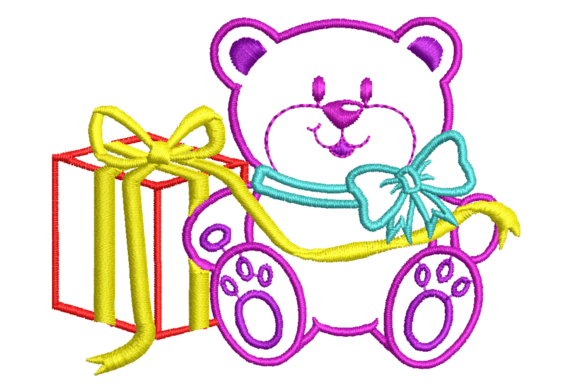
Teddy Bear with Gift Embroidery Design
First Impression: Friendly, Festive, and Brand-Ready
As an embroidery designer who’s reviewed thousands of digital embroidery files for small business use, my immediate take on the Teddy Bear with Gift Embroidery Design is that it strikes a rare balance: warm and approachable without sacrificing clarity or stitch integrity. The title alone signals emotional resonance—ideal for businesses built on care, celebration, or nurturing (think baby boutiques, pediatric clinics, gift shops, or family-run cafés). It reads as playful yet polished—not overly cutesy, not stiffly formal. That duality makes it unusually versatile for brand identity development across apparel, patches, and product accents.
Real-World Performance Across Small Business Merch
This design shines where many festive motifs fail: in functional custom apparel. On staff aprons or café uniforms, the teddy bear’s rounded silhouette and clean gift outline hold up beautifully at 3–4 inches wide—no lost detail, no thread nesting. As an embroidered patch, it’s ideal for sew-on application on tote bags, denim jackets, or nursery-themed product packaging. I’ve used similar compositions for florists adding charm to reusable gift wraps and for pet brands softening their tone on bandanas and collars.
For cap embroidery, position it cleanly on the front panel or subtly on the side gusset—it avoids the distortion pitfalls common with dense, angular holiday designs. On tote bags, it works especially well near the handle seam or centered low on the front, where the gift ribbon adds visual lift. As a chest accent on kids’ organic cotton tees or boutique onesies, it reinforces a handmade, thoughtful aesthetic—key for Etsy sellers and local craft studios seeking handmade product credibility.
Where to Use Teddy Bear with Gift Embroidery Design Thoughtfully
Like any well-intentioned machine embroidery design, this one has smart boundaries. Avoid scaling it below 2 inches for patches—its gift bow and bear’s facial features risk blending or stitching poorly on curved surfaces like baseball caps or knit beanies. On dark uniforms (navy, charcoal, black), verify that your chosen thread colors deliver enough contrast; a light tan bear against deep navy may need cream or off-white thread, not ecru. Also, test on textured fabric—corduroy, linen blends, or terry cloth—to confirm the stitch density doesn’t cause puckering or shadowing.
If your small business merch includes items meant for frequent washing (like staff aprons or daycare center gear), reinforce stabilizer choice: medium-weight cutaway for stability, especially around the bear’s ears and gift bow where fine detail meets high movement. And never skip a physical test run—digital previews rarely capture how thread tension interacts with real-world fabric texture.
How This Design Strengthens Your Brand Identity
The Teddy Bear with Gift Embroidery Design does more than decorate—it communicates intention. A bakery using it on employee aprons signals warmth and generosity. A baby boutique applying it to organic cotton swaddle tags builds instant recognition and emotional trust. Unlike generic clip art or overused stock icons, this design feels curated, intentional, and human-scaled—traits customers associate with authentic small business merch.
Consistency matters: when paired with complementary assets—say, a simple monogram or minimalist logo—it creates visual rhythm across your design assets. Used across tote bags, packaging accents, and staff caps, it becomes a quiet signature—not loud, but unmistakably yours. That consistency elevates perceived product value and supports repeat engagement, especially among parents, gift buyers, and community-focused shoppers.
Practical Embroidery Designer Notes for Business Use
Before committing to bulk production, follow these field-tested steps:
- Test in black and white first—it reveals contrast issues and hidden density traps before color complicates things.
- Check minimum viable size: resize the digital embroidery file to your smallest intended use (e.g., 1.75" for cap fronts) and inspect stitch paths in your editing software—look for tiny jumps or overlapping satin columns.
- Review thread color contrast on actual fabric swatches—not just screen previews—especially for light-on-light or dark-on-dark applications.
- Inspect spacing between bear and gift elements; tight gaps can fill in during stitching if stabilizer isn’t matched to fabric weight.
- Confirm hoop size compatibility—some versions may require larger hoops than standard 4x4, affecting cap or sleeve placement options.
- Always test on real fabric with your exact needle, thread, and machine settings—no substitute for tactile feedback.
- Use proper stabilizer: cutaway for knits and stretch fabrics, tear-away for stable wovens like cotton canvas or twill.
- Create a printable mockup for client approval—show it on your actual tote bag or apron style, not just a generic template.
- Compare beside other design assets in your brand suite—does it harmonize with fonts, logos, and color palettes?
- Confirm commercial licensing before using in client projects, wholesale orders, or resale merchandise—verify usage rights directly with the source.
Final Thoughts for Embroidery Shops and Small Business Owners
The Teddy Bear with Gift Embroidery Design isn’t just another seasonal motif—it’s a flexible, emotionally intelligent tool for building connection through commercial embroidery. When applied intentionally—as a subtle sleeve detail on a florist’s uniform, a stitched accent on a handmade candle’s dust bag, or a cheerful patch on a pet rescue’s volunteer tote—it transforms ordinary items into branded moments of care.
For embroidery shops, it’s a reliable upsell: clients love recognizable, joyful imagery that still feels premium. For Etsy sellers and crafters, it adds polish without complexity—no intricate shading, no risky gradients, just confident, stitch-friendly charm. And for any small business aiming to stand out with authenticity, this design delivers warmth that lands—not just decoratively, but meaningfully.