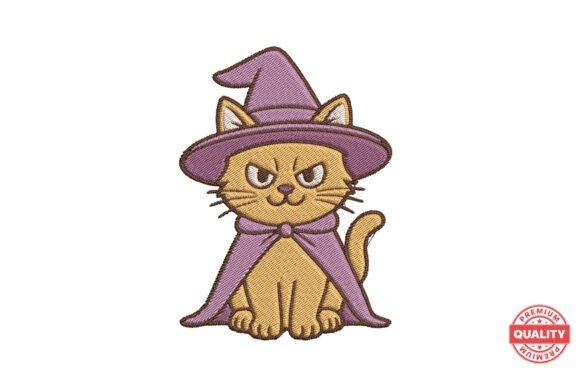
Halloween Witch Cat Embroidery
First Impressions: Spooky, Sweet, and Stitch-Ready
When I opened the Halloween Witch Cat Embroidery file, I didn’t just see a motif—I saw a mood. It’s got that perfect balance of playful mischief and seasonal charm: a stylized black cat wearing a tiny pointed hat, eyes wide with quiet magic, tail curled like a question mark. No cluttered background, no overwrought details—just clean lines, intentional negative space, and a silhouette that reads instantly at 3 inches *and* holds up beautifully scaled to 6 inches. That tells me this isn’t just a decorative graphic; it’s a thoughtfully composed machine embroidery design built for real-world use—not just screen previews.
A Real Project Test: Custom Tote Bags for a Local Boutique
Last week, I stitched the Halloween Witch Cat Embroidery onto a set of natural canvas tote bags for a small-town gift shop launching their October collection. We used medium-weight tear-away stabilizer and 40-weight polyester thread in charcoal gray and ivory. The result? Crisp satin-stitched outlines, smooth fill-stitch fur texture, and zero puckering—even across the bag’s gusset seam. Customers loved how the design landed: not too cutesy, not too scary, and unmistakably handmade. One mom bought three: one for her daughter’s trick-or-treat bag, one for her own work tote, and one as a “just because” gift for her sister. That kind of repeat resonance is rare—and it starts with a design that translates well from digital file to finished product.
Where This Design Shines (and Where It Asks for Care)
The Halloween Witch Cat Embroidery thrives on structured, stable surfaces. It’s ideal for:
- Sweatshirt embroidery—the moderate stitch density holds up without stiffness on fleece or French terry
- Embroidered patch backing (heat-seal or sew-on), especially when fused to denim jackets or backpacks
- Pillow covers and kitchen towels, where its balanced proportions frame corners or center panels elegantly
- Baby embroidery on onesies or burp cloths—its gentle whimsy reads as warm, not edgy
- Custom apparel for boutique branding, especially when paired with minimalist typography or seasonal monograms
That said, proceed with intention on:
- Stretchy fabric—like ribbed knits or lightweight jersey—where stabilizer choice (cut-away + topping) becomes non-negotiable
- Textured fabrics such as bouclé or heavy linen, where fine details (like the cat’s whiskers or hat brim) may soften visually
- Curved surfaces like caps—test hoop placement first; the design’s vertical orientation works best on front panels, not crowns
- Dark fabric—check contrast on your thread colors. A light gray or cream thread often reads more clearly than stark white on black canvas
- Tiny hoops (under 4x4 inches)—scale down only if the file includes a verified small-size version. Don’t force-resize without verifying stitch integrity.
What It Adds to Your Craft Business—Beyond the Stitch
As an Etsy seller and small shop product developer, I pay close attention to how a design affects perceived value—and the Halloween Witch Cat Embroidery quietly elevates it. Its clarity builds customer trust: when buyers see crisp edges and confident line work, they assume care was taken at every stage. That translates directly to higher perceived quality in your handmade product, whether it’s a personalized gift or a limited-run boutique item. It also supports brand consistency—pair it with muted fall palettes or modern black-and-orange combos, and it feels cohesive, not costumed. And yes, it’s highly giftable: I’ve seen customers add it to baby shower favors, teacher appreciation bundles, and even wedding weekend welcome bags (with a “spooky but sweet” note). That versatility is gold for creative entrepreneurs juggling multiple product lines.
Practical Designer Notes Before You Stitch
This isn’t a “load-and-go” file—and that’s a good thing. Thoughtful execution makes all the difference. Here’s what I do every time:
- Test on scrap fabric first—same weight, same finish, same stabilizer combo you’ll use on the final piece
- Review stitch density visually in your embroidery software. Look for any overly dense clusters (especially around the hat or eyes) that could cause stiffness or thread breaks
- Check small details at actual size: are the whiskers legible? Does the eye shape hold up after stitching, or does it blur?
- Mock it up in black and white—this reveals contrast issues before you commit thread and time
- Compare light vs. dark backgrounds using printable mockups. Some designs pop on navy but vanish on charcoal—this one holds up well on both, but verify with your chosen thread palette
- Confirm stabilizer match: medium cut-away for knits, tear-away for stable wovens, and always a light topping for napped fabrics
- Verify licensing before selling finished items or bundling the digital embroidery file as part of a craft business kit. If terms aren’t clear in the product description, reach out to the designer
Final Thought: A Seasonal Staple, Not a One-Use Gimmick
The Halloween Witch Cat Embroidery doesn’t scream for attention—it invites it. That’s why it works so well across generations and applications: toddlers giggle at the cat, teens appreciate the subtle attitude, and adults love its understated charm. It’s not just a holiday embroidery asset—it’s a reliable, reimagined design asset. Whether you’re prepping for a craft fair, building an Etsy collection, or fulfilling a custom order for embroidered aprons or pet bandanas, this design earns its place in your working library. Just remember: great embroidery isn’t about the flashiest file—it’s about the one that stitches cleanly, sells confidently, and makes your customers pause, smile, and say, “I need that.” This one does.